

20-Second Summary
Do you know approximately 200 people die on cruises every year, with a roughly 3 to 4 dying every week. Most of these deaths are due to natural issues like heart attacks, and a few occur due to accidents, murders, and suicides, too.
We will explore what happens with these dead bodies, if cruise ships have morgues to carry them, how long they can be preserved, and what kind of specialists are there to handle the dead bodies till they reach their destination ports.
Do Cruise Ships Have Morgues?
We have heard different questions raising curiosity and concerns about cruises, including:
- Do cruise ships have jails?
- Do cruise ships have hospitals?
- Do you have cruise ship jail photos?
The answer to all those is yes, just like the answer to today’s question about morgues.
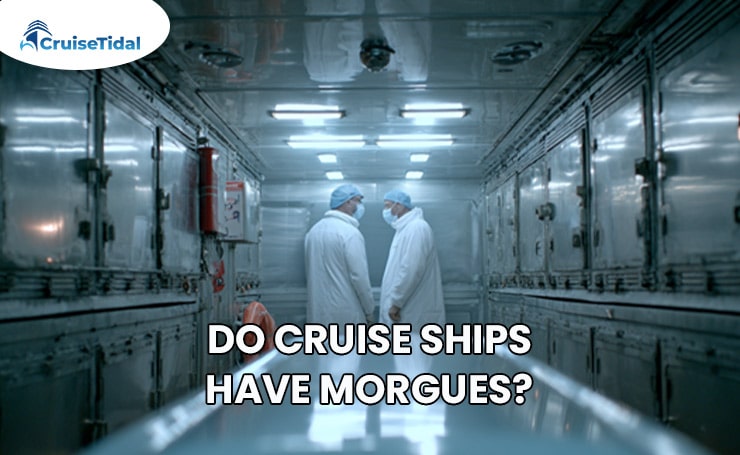
Yes, all the cruises have morgues, but they all differ in their dead body carrying capacity based on their sizes.
Based on cruise ship death statistics, the likelihood of deaths on cruises, based on 200 per year, is most likely approximately 1 in 6.25 million passengers.
Over the years, out of the reported deaths, 11 per cent were of the crew members, and 89 per cent were the passengers.
Most of the large cruises have morgues, which are usually on the lowest decks and are usually presented as a stainless steel room.
Cruise Ship Morgue Capacity
The capacity of cruise ship morgues varies by the size of the ships. Usually, based on the size, the cruise ships can carry approximately 2 to 10 dead bodies, and these are usually placed in a plastic bag and zipped up in the body bag and kept in a freezer where they can be preserved for up to one week.
The bodies are usually kept preserved until they reach the nearest port or the port of the deceased person.
To give you a better idea, we have put the information in a simple tabular form to understand the capacity of the ships, along with some ship names as examples.
| Cruise Ship Size | Average Passenger Capacity | Typical Morgue Capacity | Preservation Time in Morgue | Example Ships |
| Small (up to 1,000 passengers) | 500 to 1,000 | 2 to 3 bodies | 4–7 days | MS Braemar (Fred. Olsen), Hebridean Sky |
| Medium (1,000–3,000 passengers) | 1,500 to 2,800 | 4 to 6 bodies | Up to 7 days | Oceania Marina, Viking Sky |
| Large (3,000+ passengers) | 3,000 to 6,000+ | 8 to10 bodies | Up to 7 days, depending on voyage length | Symphony of the Seas (Royal Caribbean), Carnival Vista |
What happens when someone dies on board?
Now that we know how often people die on cruise ships, let us have a look at the complete procedure of what happens when someone dies on a cruise ship.
Usually, the procedure involves six steps from the confirmation of the death till the disembarking of the dead body. A brief description has been given below.
Step-by-step: Procedure When Someone Dies
- Confirmation of Death
First of all, when a person is reported dead, his death is confirmed by the doctors available on the vessel. Upon confirmation, when the person is declared dead, the process of storing their dead body starts along with the process of creating a record of the time of death, the reason of death, and the age of the deceased, etc.
- Storing the Dead Body
Cruise ship morgues are just made for storing bodies, and not storing the food as well, as some misconceptions have been floating about.

- The dead body is respectfully dealt with by the professional doctors and nurses available on the vessel, and put inside a body bag and refrigerated in freezers available in the stainless steel morgues located on the lowest deck of the ship.
- The body remains there till it reaches the next port or the port of its kin.
- Notifying Authorities and Kin
The authorities of the cruise, the destination port and the kin are informed about the deceased and the arrival of the body.
- Arrange Repatriation
After notifying the authorities and the family, the cruise line starts working with the officials, consulates, and the funeral homes to arrange a safe repatriation of the deceased person.
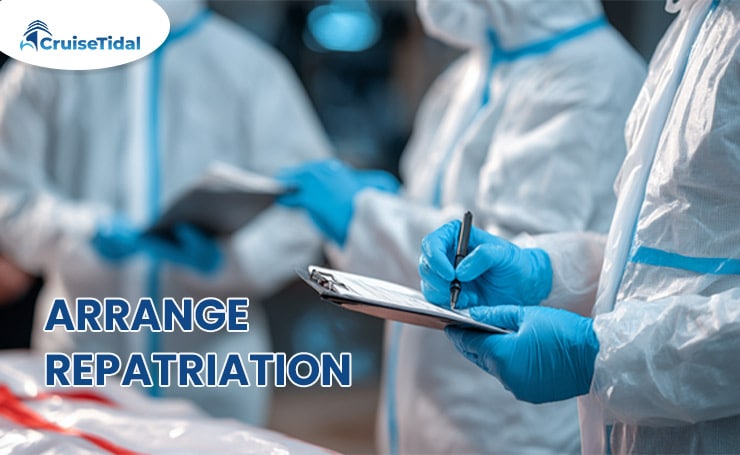
- The documents, such as the death certificate, their customs clearance, etc., are prepared.
- If the body is not close to its destination port, it might get transferred to the nearest port for the next travel if the vessel has to keep moving to another location.
- Support services
Cruise lines often have bereavement teams to provide emotional support and guidance to the family of the deceased.

- Their support services include
- Assisting with paperwork
- Coordinating with insurance providers
- Helping to manage personal belongings.
- Counselling services are made available on board in some instances.
- Disembarking
When the ship reaches the destination port of the deceased, the body is carefully removed under the supervision of port authorities, law enforcement, and sometimes local medical examiners.
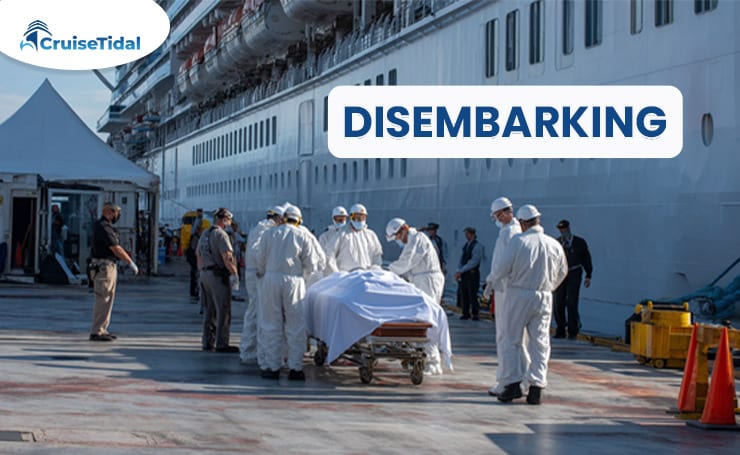
- If the death is under some special circumstances, then further investigations may be taken before handing the body to the family.
- But all this process happens discreetly, respecting the privacy of the dead person and their family.
Do cruise ships have hospitals/doctors?
We cannot say that all the cruise ships, even the big ones, have a proper hospital. But each one of them is required by the international maritime regulations to have a medical facility, often referred to as the ship’s infirmary or medical centre.

- The number of doctors may be multiple in large vessels, but usually a licensed doctor with one or a few registered nurses and medical equipment is always available on cruises, and required by maritime law.
- The medical centres have basic surgical capability, defibrillators, X-ray machines, and a small intensive care area.
- Cruise ships are equipped enough to deal with emergency situations and routine medical checkups. The doctors, nurses, and equipment are enough to stabilize the passengers with serious conditions till they land in a hospital.
- Medical staff on board operate 24/7 and are trained in:
- Emergency medicine
- Trauma care
- Infectious disease protocols.
What Types of Deaths Happen on Cruises?
Deaths do happen on cruises, but the types of deaths are usually natural, accidental, murders, and suicides. All of these have been shared below in a tabular form with real case scenarios, with the name of the cruise ship on which they happened, and the kind of death that occurred, along with the year, confirmation source, and the case status.
| Death Type | Name of Deceased | Year | Cruise Line / Ship | Reported Cause | Official Source / Confirmation | Current Status |
| Natural Death | Robert S. Jenkins | 2022 | Carnival Horizon | Cardiac arrest while at sea | Ship’s medical team & Port Authority | Case closed, natural causes confirmed |
| Natural Death | Linda Parker | 2021 | Royal Caribbean, Harmony of the Seas | Stroke onboard | Royal Caribbean medical staff | Death ruled natural, documentation filed |
| Accidental Death | Michael Harris | 2023 | MSC Seascape | Fell overboard during rough weather | U.S. Coast Guard report | Recovery confirmed, closed case |
| Accidental Death | Emily Clarke | 2019 | Norwegian Escape | Slip and fall leading to fatal injury | Ship security & medical log | Closed, no foul play suspected |
| Homicide | Ashley Barnett | 2020 | Carnival Elation | Found deceased in a cabin under suspicious circumstances | FBI & ship security report | Investigation outcome not publicly released |
| Homicide | Patrick O’Donnell | 2024 | Princess Cruises, Majestic Princess | Fatal head trauma | Australian Federal Police report | Investigation ongoing |
| Suicide | Daniel Wright | 2019 | Disney Wonder | Apparent jump overboard | Coast Guard & Disney Cruise Line statement | Ruled suicide after investigation |
| Suicide | Sarah Kim | 2025 | Celebrity Eclipse | Apparent suicide | Ship’s medical team & police at the port of call | Case pending, final report not released |
Disclaimer:
- All information provided in this table is based on publicly available sources and official statements as of the publication date.
- Since some cases are still under investigation, the details are suspected to change, so you must check for updated information for those.
- The detailed cases have been published with the names, for informational purposes only, with full respect for the individuals and families involved.
Final Remarks
Even though the occurrence of deaths across the cruise lines is low, they still occur and may be due to a natural cause, an accident or homicide.
All the cruise ships are required by international laws to have a morgue, at least one licensed doctor and registered nurses with necessary medical equipment to deal with severe cases till they reach land hospitals.
For more cruise-related updated information, keep visiting Cruise Tidal, as we keep updating you with the information you require.
Frequently Asked Questions
Do all cruise ships have morgues?
Yes, as per the maritime legal requirements, all cruise ships are required to have a morgue.
Where is the morgue located on a cruise?
The morgue on a cruise is usually located on the lowest deck of the ship.
Do cruise ships have doctors?
Yes, based on the international maritime laws, cruises require at least one licensed doctor and one or more registered nurses.
What is the cruise ship morgue capacity?
A small ship can carry 2 to 3 bodies, a medium ship can carry between 4 and 6 dead bodies, and a large ship may carry 8 to 10 dead bodies.
How are bodies preserved on cruise ships?
The bodies are typically refrigerated as a mode of preservation with temperatures maintained between 2-4°C (35-39°F).
Can passengers access the morgue on a cruise ship?
No morgues are restricted areas, and passengers are not allowed to access the morgue.
Can a cruise ship continue sailing after a passenger’s death?
Yes, the cruise ship can continue its itinerary after a death, till it reaches a port of the deceased or a port from where the body can be sent to its kin after documentation.
What happens if the morgue on a cruise ship is full?
It is a rare occurrence, but if it happens, the body can be stored in other refrigerated areas till the vessel reaches a port where it can be handed over to the authorities.
